

Josh Kamps, Crops and Soils Regional Educator
MAY
On-Farm Nitrogen Rate Optimization Research
A collection of multiple on-farm studies to better understand the optimal nitrogen rate for corn production. Results from these studies will directly influence profitable nitrogen rate decisions at the host farms and add relevant data in support of UW-Madison Extension soil fertility guidelines.
- The on‑farm studies will produce actionable nitrogen response curves that will help each cooperating farm identify its most profitable N rate, improve economic returns, and reduce unnecessary fertilizer use. Aggregated results will also strengthen statewide nitrogen recommendations, ensuring they remain relevant, data‑driven, and reflective of current production environments.
On-Farm Cover Crop Nitrogen Credit Research
An on-farm study designed to better understand the amount of nitrogen available as a nitrogen credit following a summer established clover cover crop. Results from this study will assist host farms with gaining the confidence required to adjust nitrogen rate decisions lower to reduce nitrogen input costs while maintaining crop yields.
- Results will provide growers with evidence‑based nitrogen credit values, increase confidence to reduce fertilizer inputs while maintaining expected corn yields. The findings will support decision-making for more cost‑effective nutrient management, improved profitability, and broader adoption of cover crops as a nitrogen‑supplying practice.
On-Farm Manure Nitrogen Credit Research
An on-farm study to better understand the amount of nitrogen available for corn production from an application of dairy manure. Results of this study will assist farmers with calculating an accurate level to credit the manure nitrogen through the use of nitrogen sensing technologies and corn yield comparisons between manure and no manure treatments.
- The study will provide farmers with reliable nitrogen credit estimates and will improve confidence in lowering supplemental fertilizer rates without sacrificing yield. These results will support more accurate nutrient management planning, reduced input costs, and more efficient use of manure as a crop nutrient source.
Field Trial Generator Tool Consultation
- A farm consultation with a farmer and developer to evaluate a field trial generator tool for designing replicated research trials in uniform soil zones and creating an application script to automate the precise nitrogen application by treatment area, expanding on-farm research capacity.
- The farm gained a clear understanding of how to use the tool to implement replicated, spatially sound nitrogen trials, increasing confidence in conducting future on‑farm experiments. The developer received actionable feedback to refine the tool’s functionality, and the resulting automated application script improved the precision and efficiency of nitrogen treatment placement. Together, these outcomes significantly expanded the farm’s on‑farm research potential and strengthened its capacity to make data‑driven nutrient management decisions.
Cover Crop Termination Timing Field Demonstration
A cover crop termination timing field demonstration for farmers, agronomists, and crop consultants where participants will learn about the value of delayed termination of cereal grains on weed suppression versus the risk of crop development and yield potential to inform the use of cover crops as a weed suppression and soil health tool while maintaining soybean yield potential and reducing the risk of developing herbicide resistance.
- Participants will gain a clearer understanding of how delayed termination can enhance weed suppression and reduce reliance on herbicides, while also recognizing the potential tradeoffs related to soybean emergence and yield. The demonstration will increase confidence in using cover crops as a weed‑management and soil‑health tool, helping attendees better evaluate termination strategies that maintain soybean yield potential and reduce the risk of herbicide resistance.
JUNE
Fine-Tuning Nitrogen Rates in Corn Grain Production
A study to better understand the optimal nitrogen rate for corn grain production within different farm production systems. Results from this study will help farmers, crop consultants, and conservation professionals in making nitrogen rate decisions, which maximizes profitability while reducing the risk of nitrogen
leaching or loss to the environment.The study will identify nitrogen rate ranges that consistently optimize corn grain yield within each production system while reducing the risk of nitrogen leaching or loss. These results will provide actionable, data‑driven recommendations that help farmers, crop consultants, and conservation professionals make more precise nitrogen decisions that enhance profitability and support long‑term environmental sustainability.
Legume Nitrogen Credit in Corn Production Trial
A study to better understand the nitrogen credit level available for corn from a legume cover crop planted in mid-summer following small grains the previous year. Results from this study will help farmers, agronomists, and crop consultants maximize the use of nitrogen made available through legume cover crops and more accurately identify the rate of synthetic nitrogen required for profitable corn production within this cropping system.
- The study will generate practical nitrogen credit estimates that can be reliably applied to corn grown after mid‑summer legume cover crops. These results will enable farmers, agronomists, and crop consultants to better utilize biologically supplied nitrogen, reduce unnecessary synthetic nitrogen applications, and maintain profitable corn yields while supporting improved environmental stewardship.
Nitrogen Credit from Manure Application in Corn Grain
A study to better understand the level of nitrogen credit available when manure is applied ahead of corn grain production. Results from this study will help farmers, crop consultants, and conservation professionals more accurately credit the level of nitrogen and other nutrients provided in manure for corn grain production which will improve farm profitability and reduce losses of nutrients to the environment.
The study will produce reliable nitrogen credit estimates that reflect the contribution of manure under real‑world field conditions. The results will help farmers, crop consultants, and conservation professionals more accurately account for manure‑derived nitrogen and other nutrients, enabling more precise synthetic nitrogen applications that support profitable corn production while reducing the risk of nutrient loss to the environment.
Cereal Rye and Triticale Cover Crop Termination Timing Trial
A study to better understand the target termination timing of cereal rye and triticale to provide a 50% reduction in weed biomass while not impacting the yield potential of soybean. Results from this study will help farmers, agronomists, and crop consultants in managing cover crop biomass accumulation as a tool for weed suppression while reducing the risk of herbicide resistance development.
- The study identified termination windows that consistently achieved approximately a 50% reduction in weed biomass while maintaining soybean yield potential. These results provide actionable recommendations that support farmers, agronomists, and crop consultants in using cover crop biomass accumulation to suppress weeds, strengthen integrated weed management programs, and reduce reliance on herbicides, which lowers the risk of herbicide resistance development.
Grazing Management Farm Consultation
A farm consultation with a farmer seeking advice on grazing management of Reed canary grass where resources and recommendations were provided. Through this farm consultation, the farmer has the tools necessary to make an informed decision on utilizing the section of their farm with Reed canary grass to increase available on farm forage for the beef herd, which will reduce the need for purchased forage and will increase farm profitability.
- Following the consultation, the farmer now has the tools and confidence to make an informed decision about utilizing Reed canary grass as part of the beef herd’s forage supply. This will increase available on‑farm forage, reduce dependence on purchased feed, and ultimately improve the farm’s profitability.
Crop Scout Field Day
A field day for beginning crop scouts and early career agricultural professionals, where participants learned crop scouting methodologies, pest management identification and techniques to better understand the role and responsibilities of crop scouting, which is the first step of an integrated pest management (IPM) plan and is integral to making decisions for crop productivity and profitability.
- This field day provided attendees with beginner crop scouting tools and resources for them to understand how and what to look for when crop scouting a field, and how what is seen while
in the field will affect management decisions.
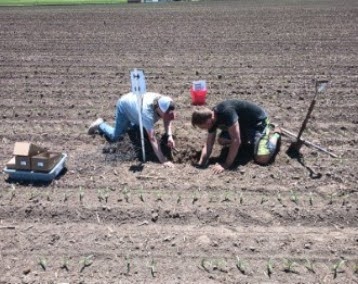
Installing soil sensors for the trial
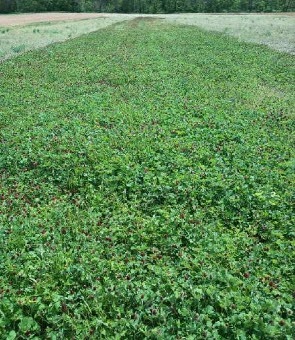
Crimson clover cover crop treatment area
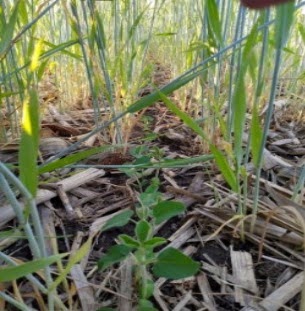
Soybean development at the time of cereal rye termination
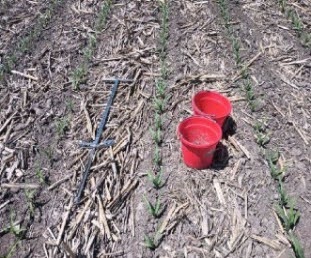
Tools for collection of soil samples ahead of nitrogen application