

 Question:
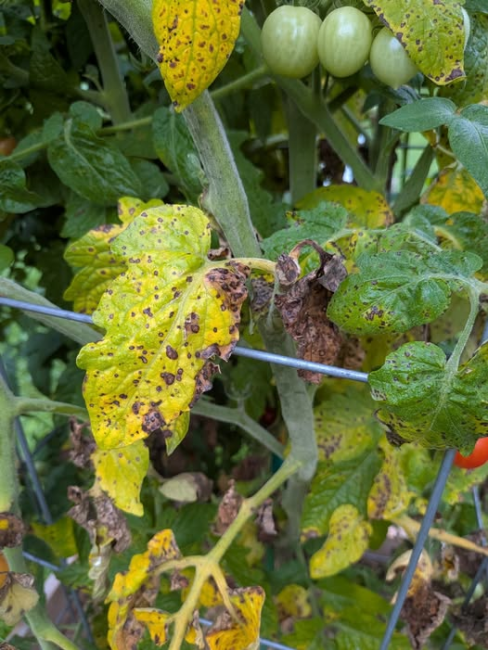
What’s going on with my tomato plants (see picture)?
 Answer:
If your tomato plants are starting to look like the one in the picture, do not panic. Fungal infections are VERY common for tomatoes in Wisconsin, especially given our weeks of high humidity and periods of heavy rain lately. There are two common diseases that affect tomatoes called Septoria leaf spot and early blight and their symptoms are very similar. The only way to confirm which disease is present would be by sending a sample to the UW-Madison Plant Disease Diagnostic Clinic (PDDC) for further testing. That being said, the focus for managing these diseases is on prevention.
Fungal diseases thrive in moist or damp, humid conditions. Make sure to have good airflow around the plants – don’t overplant or crowd them, use selective pruning, use supports, etc. You can carefully prune out the diseased leaves and dispose of them (put them in a garbage bag and landfill them). You don’t want to prune them and leave them laying in the bed as that is a source of the pathogen. And if there is any other careful pruning you could do to open up some airflow around the plants as they look crowded.
Avoid overhead watering – e.g. do not shower the plant when you water or use a sprinkler. Only water at the soil level. Avoid splashing any water on the leaves or any splashback from the soil onto the leaves.
Mulch around the plants to help prevent splashback. But don’t apply too much mulch that would create too moist of an environment.
If possible, rotate crops. I know that can be hard in a raised bed situation. Were all the tomato plants in one bed last year? Could they be planted in a different bed from year to year? At the end of every season, make sure to remove all plant material and mulch out of the beds so that the spores have less to overwinter on. Fungal spores can overwinter on leftover plant debris in the soil. These fungal spores are also present in the environment and are airborne.
There are no soil treatments. Fungicides labeled for use on vegetables and containing copper or chlorothalonil may also provide control of either of these diseases IF they are carefully applied very EARLY in the course of the disease (before symptoms develop is best) and on a regular basis throughout the rest of the growing season. If using any sort of fungicide, make sure you read and follow the label.
Learn more:
Septoria leaf spot – https://hort.extension.wisc.edu/articles/septoria-leaf-spot/
Early blight – https://hort.extension.wisc.edu/articles/early-blight/
UW-Madison Plant Disease Diagnostic Clinic – https://pddc.wisc.edu/
Have a question of your own?
Reach out—we may feature it in an upcoming post!
You can reach Julie, your local horticulture educator by calling 262-741-4958, Text 262-374-4191, email julie.hill@wisc.edu or use our online form: go.wisc.edu/PlantQ


Contact Your Walworth County Horticulture Specialist
Julie Hill – Horticulture Educator
Jefferson, Rock, and Walworth Counties
julie.hill@wisc.edu
262-741-4958
Looking for expert advice on a lawn, landscape or gardening issue? Fill out the Ask A Gardening Question form and attach photos showing your garden concern. A Wisconsin Extension Master Gardener or Extension staff will respond to your inquiry.